Official Interactions With Family Members/cohabitants and Dating Relationships
Pew Enquiry Center has long studied the changing nature of romantic relationships besides equally the role of digital technology in people's lives. This particular report focuses on the patterns, experiences and attitudes related to digital technology utilize in romantic relationships. These findings are based on a survey conducted Oct. 16 to 28, 2019, among 4,860 U.S. adults. This includes those who took part as members of Pew Research Center's American Trends Panel (ATP), an online survey panel that is recruited through national, random sampling of residential addresses, equally well every bit respondents from the Ipsos KnowledgePanel who indicated that they identify as lesbian, gay or bisexual (LGB). The margin of sampling error for the full sample is plus or minus two.one percentage points.
Recruiting ATP panelists by phone or mail ensures that nearly all U.S. adults have a risk of selection. This gives us confidence that any sample can represent the whole U.S. adult population (meet our Methods 101 explainer on random sampling). To farther ensure that each ATP survey reflects a counterbalanced cross-section of the nation, the data is weighted to match the U.S. developed population past gender, race, ethnicity, partisan affiliation, education and other categories.
For more, see the study's Methodology. You tin as well find the questions asked, and the answers the public provided in the topline.
Amid growing debates about the impact of smartphones and social media on romantic relationships, a Pew Research Centre survey conducted in Oct 2019 finds that many Americans see some tech-related struggles with their meaning others.
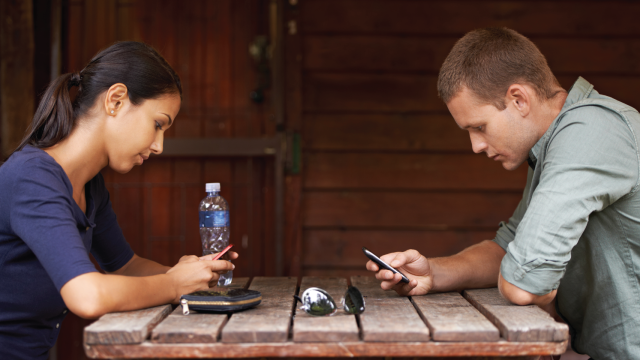
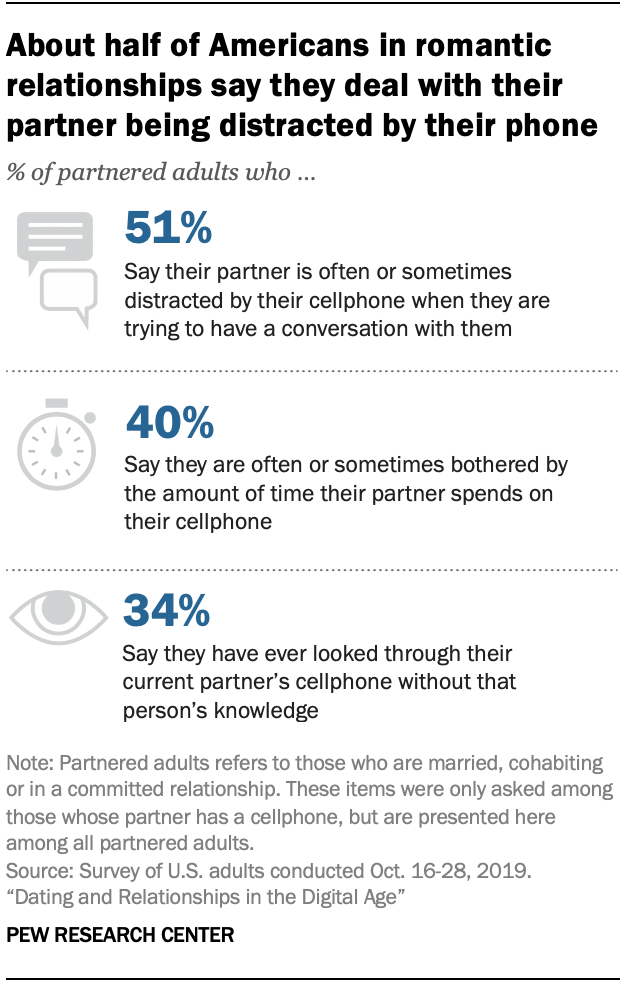 For instance, among partnered adults in the U.S. – that is, those who are married, cohabiting or in a committed relationship, roughly half (51%) say their partner is often or sometimes distracted past their cellphone while they are trying to have a conversation with them, and four-in-ten say they are at least sometimes bothered by the amount of time their partner spends on their mobile device.
Partnered adults nether the age of 50 are specially likely to limited the feeling that their partner is distracted past their phone, with those ages 30 to 49 about likely to study this. Fully 62% of thirty- to 49-year-olds and 52% of 18-to 29-twelvemonth-olds who are in a romantic relationship say their partner is at least sometimes distracted by their phone when they're trying to talk them. Notwithstanding, this issue is not confined to younger historic period groups: 41% of partnered Americans ages 50 and older say they have encountered this in their relationship at least sometimes.
With phones being such a lark, people might be tempted to look through their partner's phone. However, in that location is widespread agreement amidst the public that digital snooping in couples is unacceptable. Seven-in-x Americans – regardless of whether they are in a human relationship – say it is rarely or never acceptable for someone to look through their partner'southward cellphone without that person's knowledge. Still, 34% of partnered adults say they take looked through their partner'southward cellphone without that person'due south noesis, with women being more probable than men to say they have done this (42% vs. 25%).
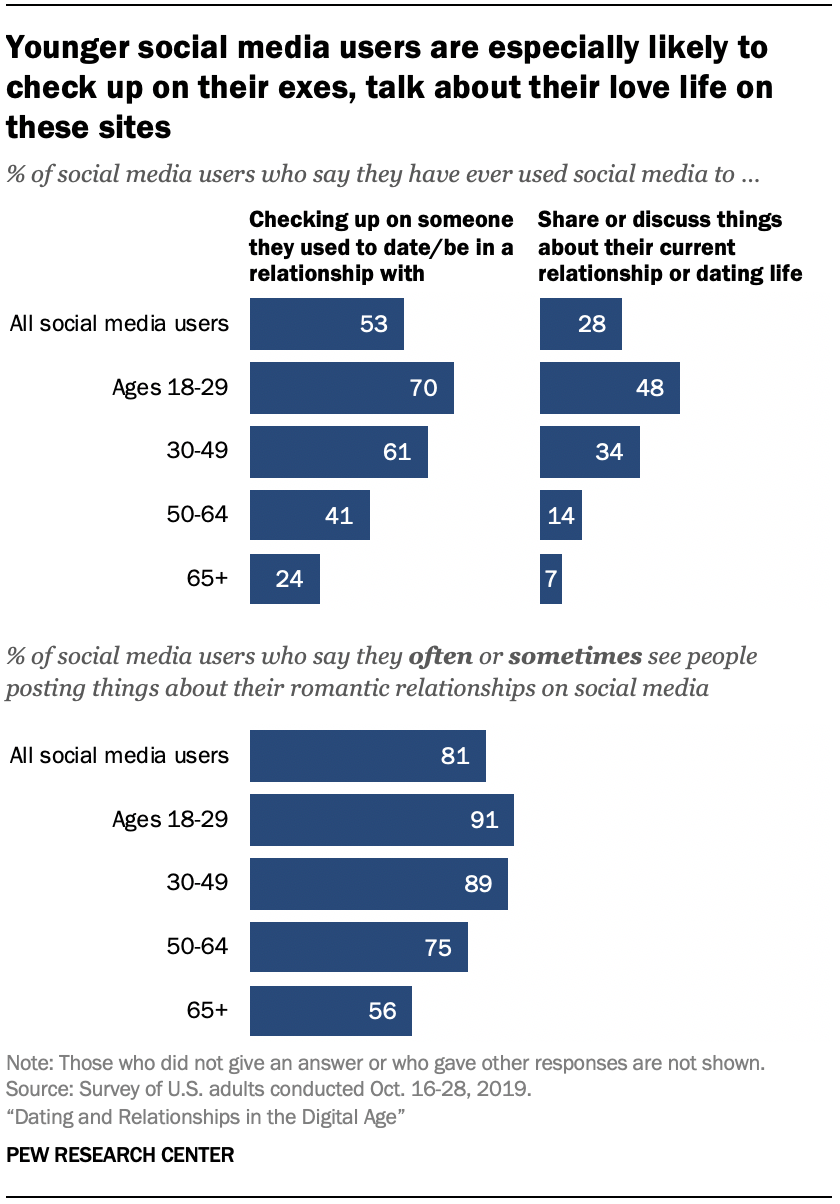 For many adults, social media plays a role in the fashion they navigate and share information about their romantic relationships. Roughly eight-in-ten social media users (81%) report that they at least sometimes encounter others posting well-nigh their relationships, including 46% who say this happens often, but few say that seeing these posts affects how they feel about their own dear life.
Moreover, social media has become a place where some users discuss relationships and investigate old ones. Roughly one-half of social media users (53%) say they accept used these platforms to check up on someone they used to engagement or be in a relationship with, while 28% say they take used social media to share or discuss things about their relationship or dating life. For adult users under the historic period of thirty, those shares who have used social media to checked-up on a onetime partner (seventy%) or posted about their own honey life (48%) are even higher.
Merely social media can also be a source of annoyance and conflict for some couples. Among those whose partner uses social media, 23% say they have felt jealous or unsure of their human relationship because of the way their current partner interacts with others on these sites, and this share rises to 34% amid those ages 18 to 29.
Still, some users view these platforms every bit an of import venue for showing love and amore. This is especially truthful for younger users who are partnered: 48% of 18- to 29-year-old social media users say social media is very or somewhat important for them in showing how much they intendance about their partner.
These are some of the main findings from a nationally representative survey of 4,860 U.S. adults conducted online Oct. 16 to 28, 2019, using Pew Research Centre'southward American Trend Panel.
Terminology
Several terms are used in this report to describe people's electric current relationship condition. This reference guide explains each term.
Single is used to describe people who are not currently in a committed human relationship just may exist casually dating (31% of the sample).
Unmarried and looking refers to people who are not in a committed relationship (but may be casually dating) and are looking for dates or a human relationship (15% of the sample).
Casually dating refers to single people who are casually dating someone but are not in a committed human relationship (4% of the sample).
Partnered refers to adults who are married, cohabiting or in a committed relationship (69% of the sample).
Cohabiting is used to describe people who currently alive with their partner only are not married (11% of the sample).
Committed relationship is used to draw people who are in a relationship but are not married or cohabiting (8% of the sample).
Single is used to refer to any adults who are non currently married – single, cohabiting or in a committed relationship (50% of the sample). This term is sometimes used in conjunction with the term "partnered" to refer to those who are cohabiting or in a committed relationship (for example, unmarried partnered adults constitute 19% of the sample).
twoscore% of partnered adults say they are bothered past the amount of time their partner spends on their cellphone
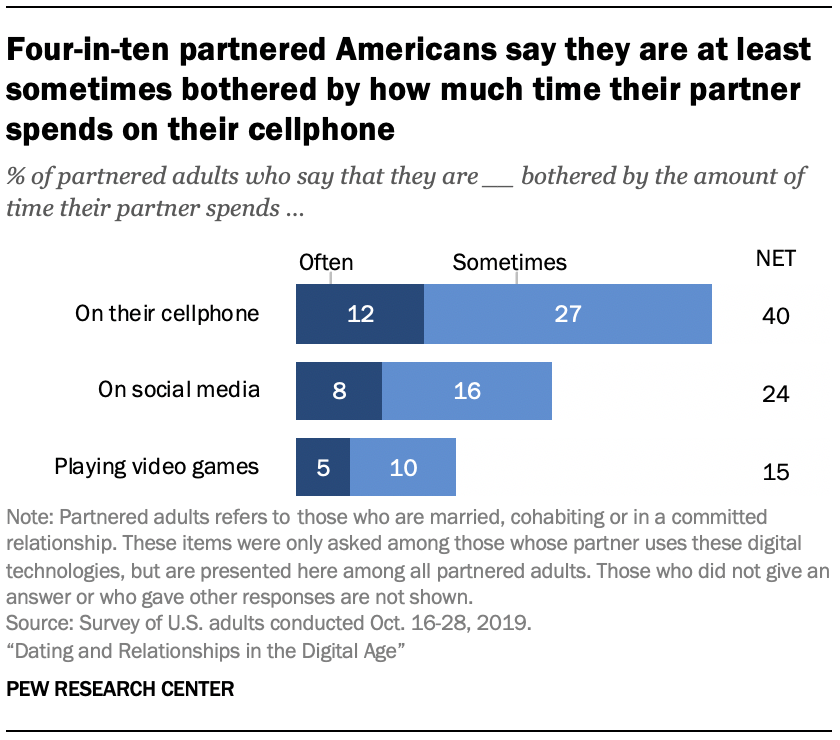 At the time of the survey, four-in-10 Americans who are married, living with a partner or who are in a committed relationship say they are often or sometimes bothered by the amount of time their partner spends on their cellphone, including 12% who say they feel this way often.one
In improver, 24% of partnered Americans report that they are at least sometimes bothered past the amount of time their partner spends on social media, while a somewhat smaller share (15%) say they feel this mode virtually their partner playing video games.
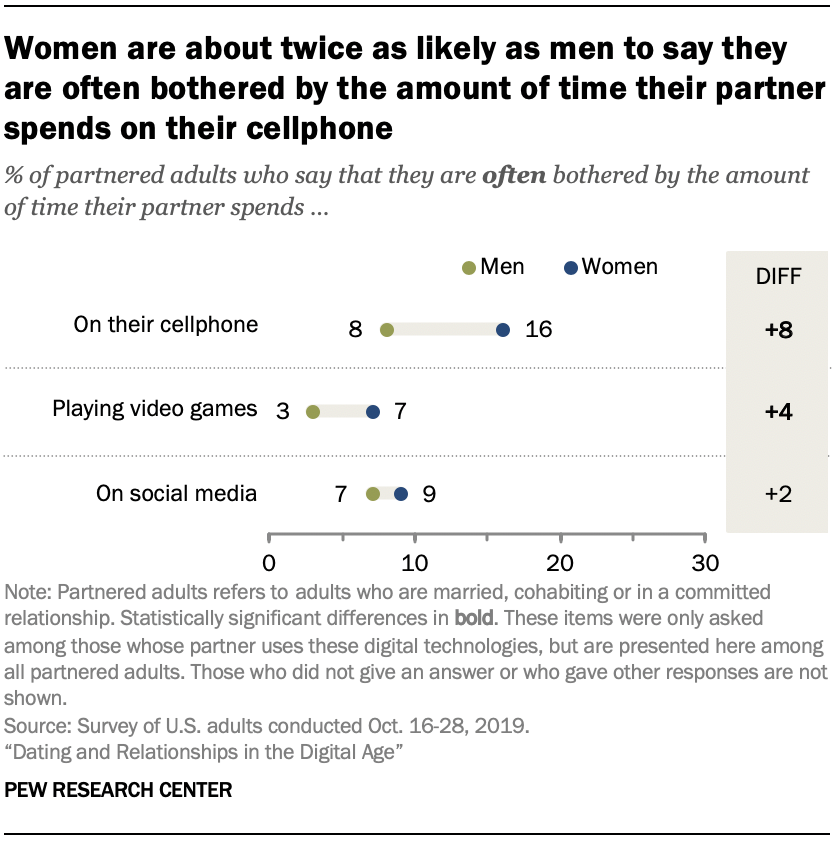 There are certain groups who are more likely to express annoyance over their partner's digital activities than others. Amongst partnered adults, women are more than likely than men to say they are often bothered by the amount of fourth dimension their partner spends on their cellphone (xvi% vs. 8%) or playing video games (7% vs. 3%).2
Across gender differences, people'southward attitudes too vary by age. Some eighteen% of partnered adults ages 18 to 49 say they are often bothered by the amount of time their partner spends on their phone, compared with 6% of those ages 50 and older. Younger adults in romantic relationships also are more than likely than their older counterparts to say they are often bothered by the amount of time their partner spends on social media (eleven% vs. 4%) and playing video games (7% vs. 3%).
Roughly half of partnered people say their significant other is distracted by their telephone at least sometimes when they endeavour to talk to them
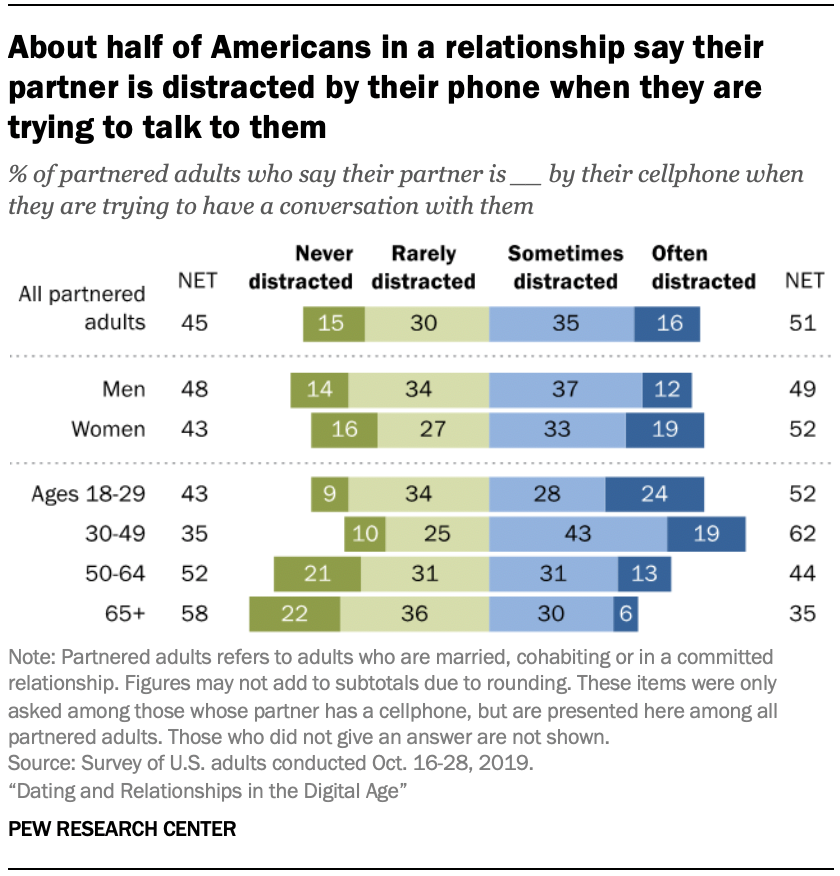 While relatively few Americans are familiar with the term "phubbing" – which is the practise of snubbing others in favor of their cellphones – notable shares say they have encountered that behavior in their romantic relationships.
When asked to reverberate on their partner's cellphone use, 51% of Americans in a romantic relationship say their partner is at to the lowest degree sometimes distracted by their cellphone when they are trying to take a conversation with them, including 16% who say their meaning other is ofttimes distracted by their mobile device.
This design differs by age: Roughly six-in-x partnered adults ages thirty to 49 say their significant other is at least sometimes distracted by their cellphone when they are trying to concur a conversation with them, compared with 52% of those ages 18 to 29 and even smaller shares for those ages l and older (41%). Among those in relationships, younger adults also are more than likely than older adults to assert that their partner is often distracted by their phone when they are trying to take a discussion (twenty% vs. 10%).
Women who are in a human relationship are more than likely than men to say their partner is often distracted by their phone while they are trying to concur a conversation, but this gender deviation is most pronounced among younger adults. Three-in-ten partnered women ages eighteen to 29 say their significant other is ofttimes distracted by their phone while they are trying to hold a conversation, compared with 15% of men in this historic period group who say this.
About one-in-three partnered adults say they take looked through their current spouse or partner's phone without their knowledge, only there'southward stiff public consensus this is unacceptable
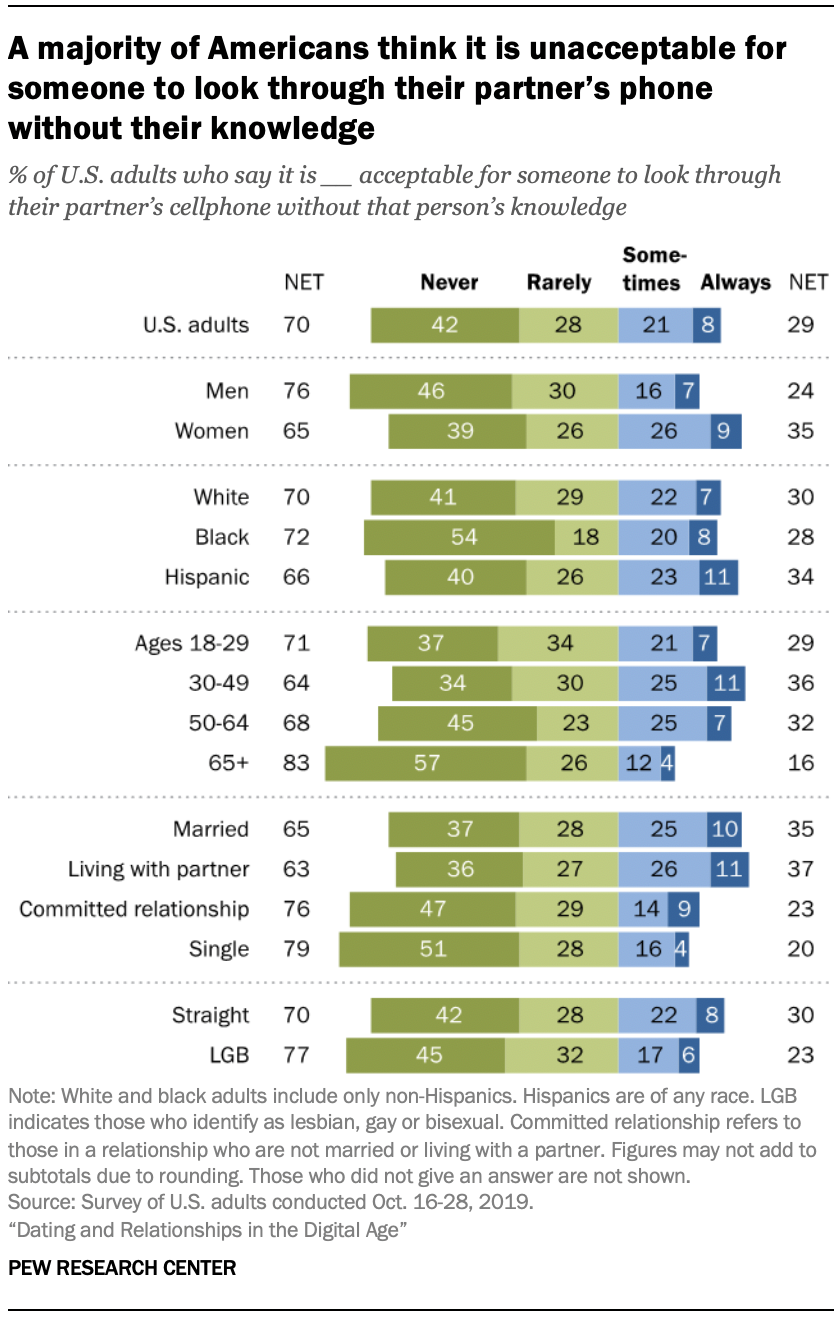 Americans – regardless of whether they are in a relationship – were asked in the survey about their views about some bug related to technology and relationships. For example, they weighed in on the acceptability of looking through a meaning other's phone without that person's knowledge. Vii-in-x U.S. adults say it is rarely (28%) or never (42%) acceptable to look through a pregnant other'south cellphone without their knowledge. Smaller shares – about three-in-x (29%) – view this behavior as at least sometimes acceptable.
Majorities across major demographic groups view these actions every bit unacceptable, but there are some Americans who are more accepting of this beliefs than others.
Women are more than likely than men to remember it is at to the lowest degree sometimes acceptable for someone to wait through their partner'southward cellphone without their noesis (35% vs. 24%). And most one-third of adults nether the historic period of 65 (33%) view this as acceptable, compared with 16% of those 65 and older.
Americans' views on the acceptability of looking through a partner's telephone varies by current human relationship status. Americans who are married or cohabiting are more than likely than those who are single or in a committed relationship to say that looking through a significant other'southward phone without that person's knowledge is sometimes or always acceptable.
 Despite the overall public uneasiness with this type of digital snooping, there are some Americans who study that they take looked through their meaning other'south telephone without that person'south knowledge. Roughly i-third of partnered adults (34%) say they take done this, but at that place are substantial differences past gender, age and relationship status when it comes to looking through a significant other's phone.
Amid adults who are partnered, women are far more likely than men to report that they accept looked through their electric current partner'due south phone without that person'due south knowledge (42% vs. 25%). And while 52% of partnered adults ages eighteen to 29 say they have washed this, those shares are 41% amongst those ages 30 to 49, 29% amid those ages fifty to 64 and xiii% amid those 65 and older.
These actions besides vary by the blazon of relationship. Roughly 4-in-ten Americans (41%) who are living with a partner written report that they have looked through their electric current partner's phone without that person's noesis, compared with 27% of those who are in committed relationship and 34% of those who are married. Nonetheless, this blueprint is largely due age differences in relationship condition, every bit twice as many adults nether fifty alive with a partner than practise those l and older. While 48% cohabiters under 50 study having gone through their partner's phone without that person'south knowledge, simply 18% of cohabiters ages 50 and older say the same.
There also are some differences by race and ethnicity. About half of Hispanic adults who are in a human relationship say they have looked through their partner'due south telephone, compared with a third amongst their black or white counterparts.
Those in partnered relationships also are more probable to wait through their partner'south cellphone without that person's cognition if they call up information technology is adequate to practice and so (61% say they have washed this). Smaller shares of partnered adults who deem this unacceptable say they take personally gone through their current partner's phone – though nonetheless about i-in-five say they accept done this.
It is fairly common for partners to share the password or passcode to their cellphone
Overall, sharing passwords to digital devices or accounts is a fairly common do in romantic relationships. In the October 2019 survey, a majority of Americans who are married, cohabiting or in a committed relationship say they take given their spouse or partner the password for their cellphone (75%), their email business relationship (62%) or whatsoever of their social media accounts (42%).3
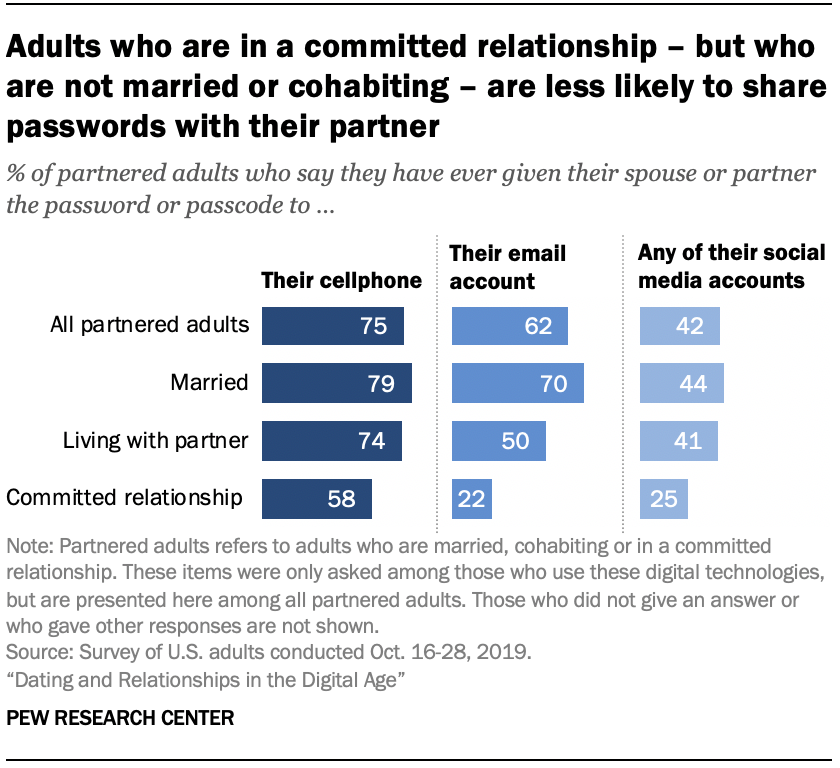 Still, experiences practise vary depending on the type of relationship partnered people accept. Married or cohabiting adults are much more likely to share their cellphone or social media passwords with their partner than those who are in a committed relationship just are not living with their partner. Roughly 3-quarters or more of married adults (79%) or those who live with a partner (74%) say they take given their partner the password to their cellphone, compared with 58% of those who are in a committed relationship. A similar pattern is present among partnered social media users when they are asked nearly whether they have shared their login information for any of their social media accounts. When it comes to e-mail password sharing, married adults are the most probable group to say they have given their email password to their partner: 70% say this, compared with 50% of cohabiting internet users and just 22% of those in a committed relationship.
There also are some differences by age. Among partnered adults, those ages xviii to 49 are more than likely than those ages 50 and older to say they accept given their cellphone countersign to their spouse or partner (81% vs. 69%). On the other hand, older adults are more likely than younger adults to say they have shared their email password with their significant other (70% vs. 59%).
Nearly social media users see other people post virtually their relationship or dating life, but relatively few say these posts touch on how they experience about their own relationship
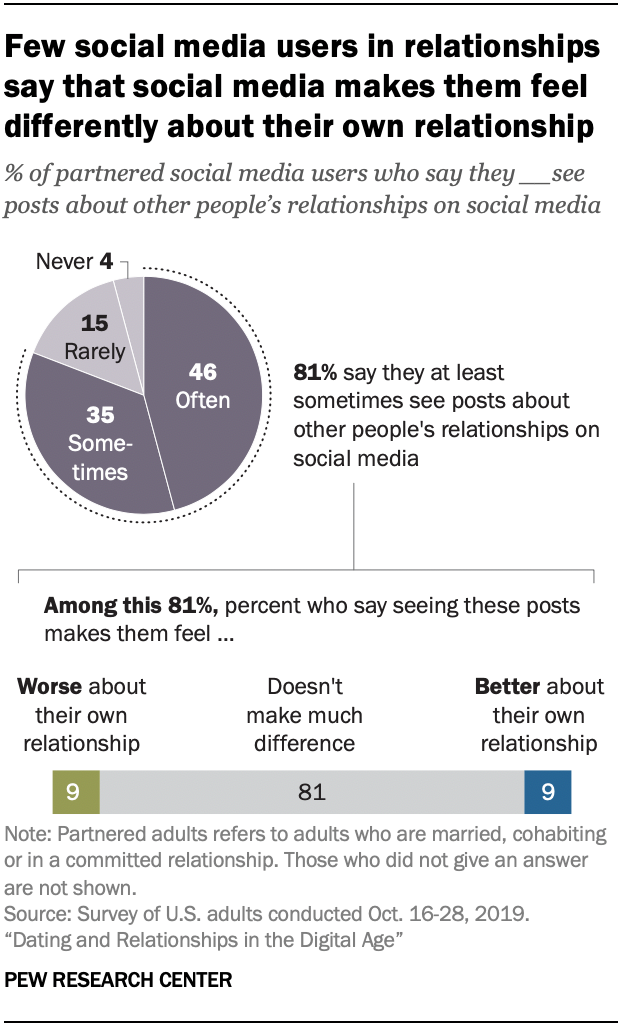 This survey conducted concluding fall also examined how social media might exist affecting the way people retrieve about their own beloved lives. More specifically, does seeing relationship posts on social media touch the mode people think most their own relationships?
Overall, viii-in-10 social media users encounter others post about their human relationship on social media often or sometimes. This differs by both age and gender. Women are slightly more probable than men to see these posts (84% vs. 77%). In addition, ninety% of social media users ages xviii to 49 say they see these types of mail service at to the lowest degree sometimes, compared with 68% of those ages fifty and older.
A majority of social media users who are in a human relationship (81%) say they see posts about other people's relationships when using social media. Amidst these partnered social media users, 78% of those who are married say they at least sometimes see posts nearly other people's relationships, compared with 89% of those who are living with partner and 86% of those in a committed relationship.
Overall, seeing these posts appears to have niggling effect on how people view their own romantic relationships. A large bulk of partnered adults (81%) who at to the lowest degree sometimes see posts nigh other people'southward relationships say that these posts have not fabricated much of departure in how they feel about their own relationship. On the other hand, relatively few say these posts make them feel better (9%) or worse (9%) about their relationship.
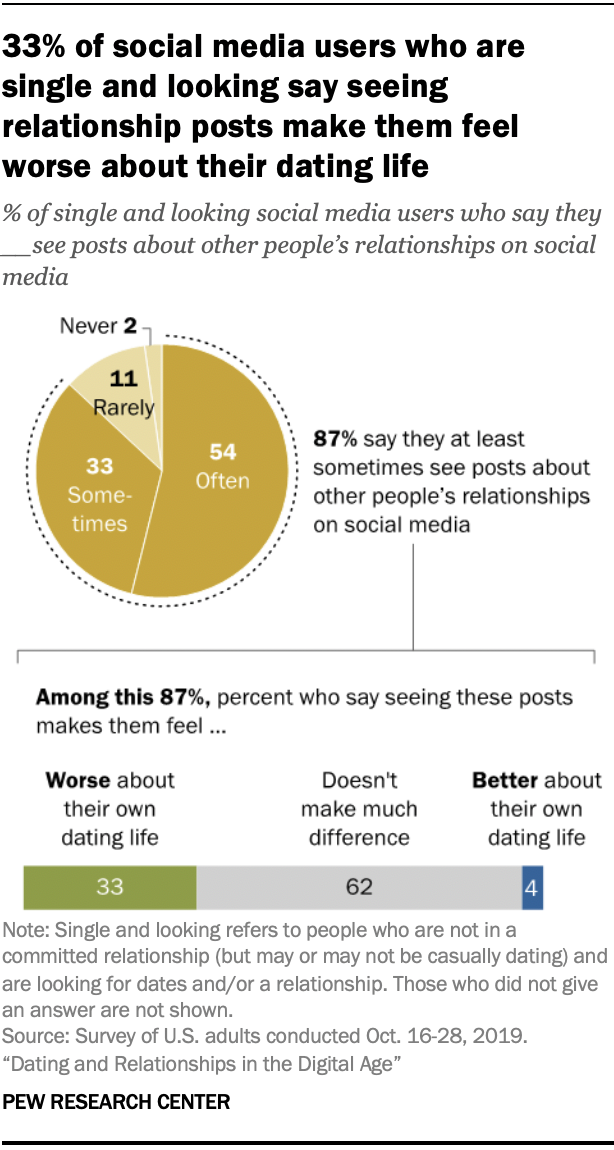 When it comes to social media users who are single and looking, 87% see other people making posts most their relationships on social media platforms at to the lowest degree sometimes. Social media users who are unmarried and not looking for a relationship or dates are less likely to report seeing these types of posts at to the lowest degree sometimes (78%).
A 3rd of the social media users who are single and looking and who say they see others' posts near their beloved life say that seeing these posts makes them experience worse. This compares with 62% who written report that such posts by others do not make much of a difference in how they feel about their own dating life. Just 4% say information technology makes them feel better.
These relationship-focused posts tend to accept a bigger impact on women than men. Among social media users who are single and looking, women who see relationships posts at least sometimes are more likely to report that seeing these posts on social media makes them feel worse about their dating lives than are their male counterparts (40% vs. 28%).
About iii-in-ten social media users say they take discussed their dear life on social media
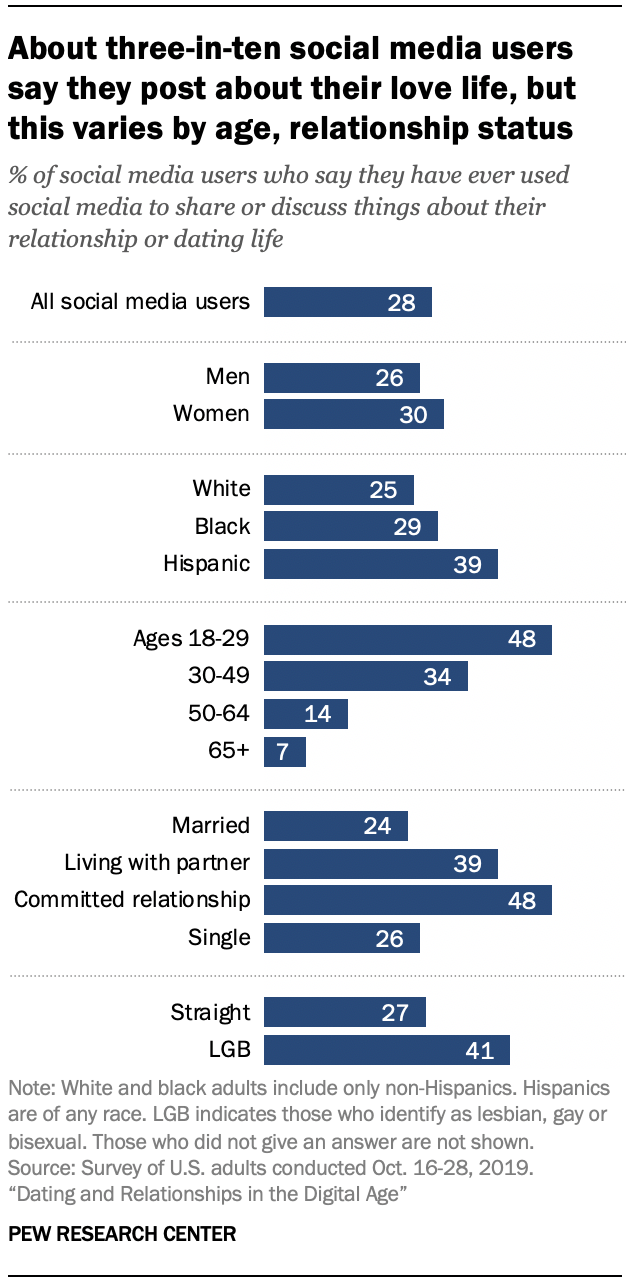 While it is adequately common for social media users to come up across other people posting things about their love lives, merely a minority of Americans who apply these platforms (28%) say they have ever shared or discussed things about their relationship or dating life. About four-in-10 adults who are living with their partner (39%) and about half of those in a committed relationship (48%) but not living together say they accept ever posted about their relationship on social media. Conversely, married and single adults are the least likely to post well-nigh their beloved lives (24% and 26%, respectively).
Nigh four-in-10 social media users who are either Hispanic or lesbian, gay or bisexual (LGB) say they have ever posted about their dating life or human relationship on social media, while around 1-quarter of white, black and direct social media users say the same.
Younger social media users too are more than likely to have posted well-nigh their love lives on social media previously. While about half of social media users ages 18 to 29 take e'er posted on social media about their dating life or relationship, a third of thirty- to 49-year-olds say the aforementioned. Past comparison, far fewer social media users ages fifty and older (11%) say they ever post about their relationship or dating life.
Roughly half of social media users have used these sites to check up on an ex-romantic partner
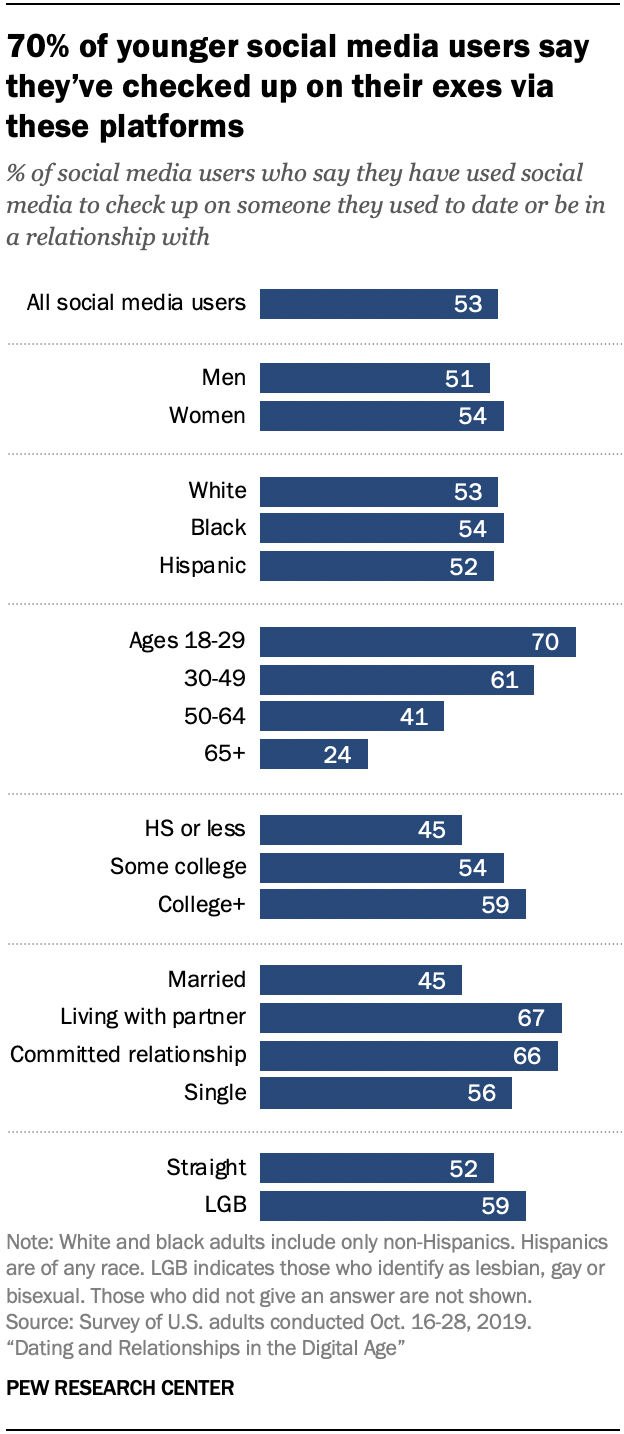 Using social media to bank check upwardly on old romantic partners is a fairly common practice among social media users. About half of social media users (53%) say they have used these sites to check up on someone with whom they were in a relationship or whom they used to date.
Social media users ages eighteen to 49 are far more than likely than those ages fifty and older to report using social media to cheque up on an ex-romantic partner. 7-in-10 eighteen- to 29-year-olds report that they have used these platforms to check up on someone they used to date or exist in a relationship with. That share is lower – though notwithstanding a bulk – among users ages 30 to 49 and falls sharply among those ages and 50 and older.
At that place also are some notable differences, depending on a person's relationship condition. About ii-thirds each of social media users who are cohabiting or in a committed human relationship say they have used social media to bank check up on someone they used to date. Meanwhile, 56% of single people, and even fewer married people (45%), say the same. In addition, social media users who take a high schoolhouse degree or less pedagogy are less likely to study that they have used to social media to cheque up on an ex-romantic partner than those with a bachelor'south or advanced degree or who accept some college experience.
Younger Americans in relationships are especially likely to view social media as having an important role in connecting and keeping up with their partner
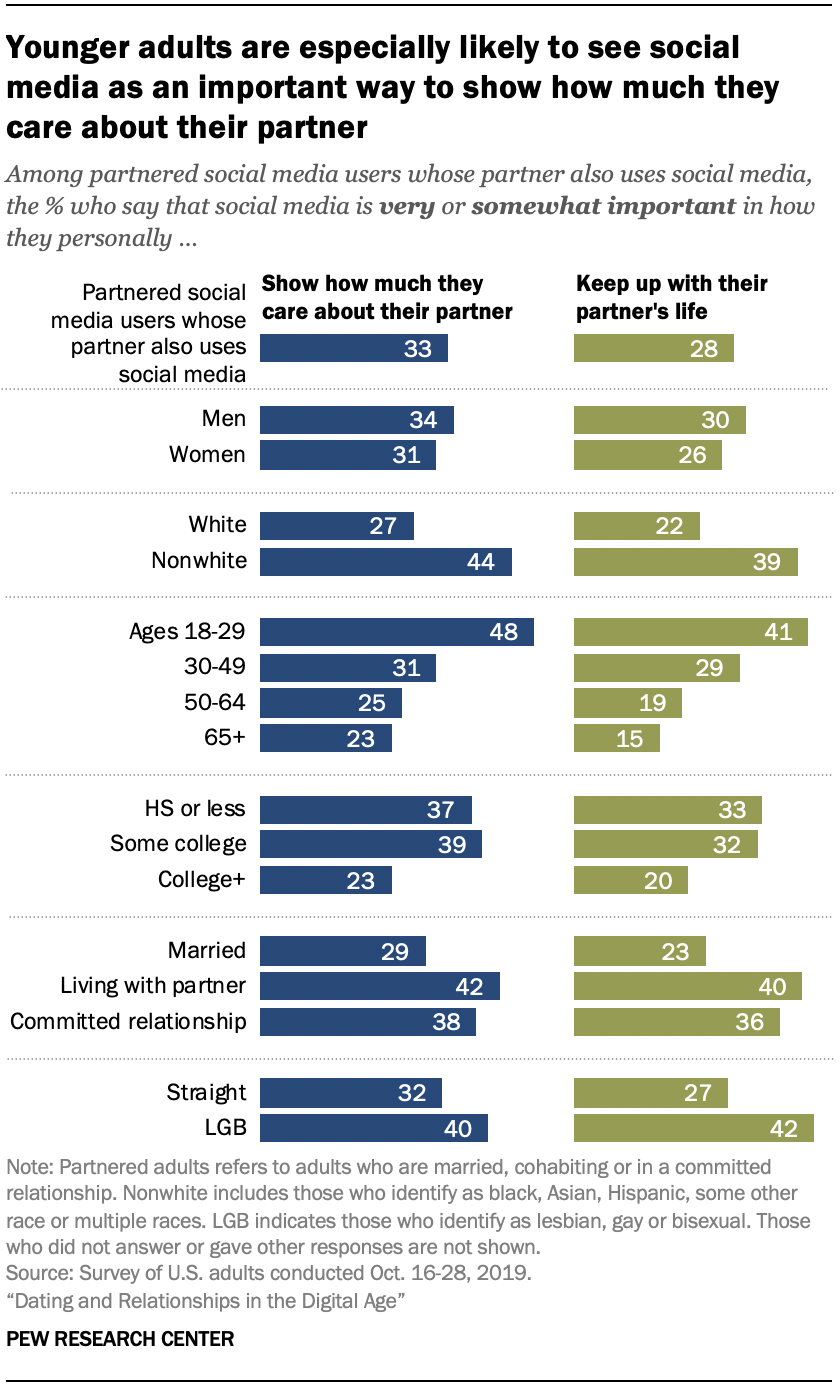 Overall, nigh 3-in-ten partnered adults who apply social media say that these sites are at least somewhat important in showing how much they care most their partner (33%) or keeping up with what is going on in their partner's life (28%). Only the level of importance that these users place on social media varies substantially by age. Among partnered social media users, 48% of 18- to 29-year-olds say these platforms are very or somewhat of import in how they show how much they care about their partner, compared with 28% of those ages xxx and older who say this.
At that place likewise are age differences when it comes to the importance social media users identify on these platforms for keeping upwards with their significant other's life. About four-in-ten partnered users ages eighteen to 29 say social media is somewhat or very of import when it comes to keeping up with what'due south going on in their partner's life, compared with 29% of those ages xxx to 49 and but 17% of those ages 50 and older.
Married social media users are more likely than those who are cohabiting or in a committed human relationship to say they do not see social media equally important for keeping upward with what's going on in their partner's life or for showing how much they care about their partner.
The level of importance that partnered adults place on social media also varies past race and ethnicity also as by sexual orientation. Nonwhite social media users are more than likely than white users to say these platforms are a very or somewhat important for keeping upwardly with their partner's life and showing how much they care.4 Among partnered social media users, LGB adults are more likely than those who are directly to say social media is at least somewhat important for keeping upward with their partner's life or showing how much they care.
Even when controlling for age, racial and indigenous differences persist when it comes to the likelihood of saying social media is a personally important mode to go along up with one's partner or testify how much they care. Similarly, marital status and sexual orientation are significant predictors of how important it is for people to utilize social media to proceed upwards with 1's partner, even after controlling for historic period differences.
Social media can be a source of jealousy and uncertainty in relationships – especially for younger adults
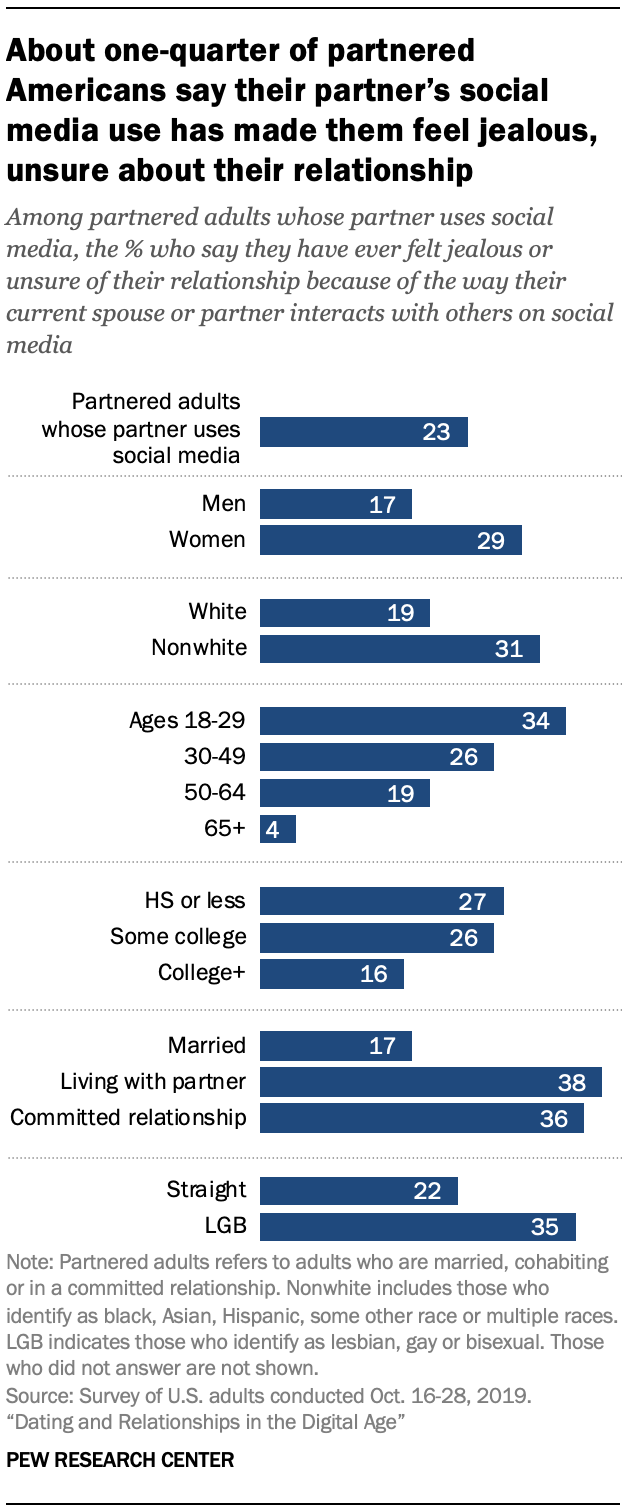 Even as younger Americans value social media as a place to share how much they care about their partner or to keep upward with what'due south going on in their partner'due south life, they as well acknowledge some of the downsides that these sites can have on relationships.
Overall, 23% of partnered adults whose meaning other uses social media say they have felt jealous or unsure virtually their relationship because of the way their current spouse or partner interacts with other people on social media. But this share is even higher amidst those in younger historic period groups.
Among partnered adults whose significant other uses social media, 34% of 18- to 29-yr-olds and 26% of those ages 30 to 49 say they have felt jealous or unsure in their electric current human relationship because of how their partner interacted with others on social media, compared with 19% of those ages 50 to 64 who say this and 4% of those ages 65 and up. Nearly four-in-ten single adults with partners who are social media users (37%) say they have felt this way about their current partner, while just 17% of married people say the same.
Women also are more likely to express displeasure with how their significant other interacts with others on social media. Women who say their partner uses social media are more probable than men to say they have felt jealous or unsure of their relationships because of how their partner interacts with others on social media (29% vs. 17%).
Among those whose partner uses social media, most three-in-10 nonwhite adults who are in a relationship report having felt jealous or uncertain in their current relationship based on their partner's social media interactions, compared with 19% of white adults who say the same. Nearly i-3rd of LGB partnered adults whose significant other uses social media report that they have felt jealous or unsure in their current human relationship because of how their partner interacted with others on social media, while 22% of directly people say this. Higher graduates are less likely to study having felt this way than those with some college experience or a high school degree or less.
Source: https://www.pewresearch.org/internet/2020/05/08/dating-and-relationships-in-the-digital-age/
0 Response to "Official Interactions With Family Members/cohabitants and Dating Relationships"
Post a Comment